
Imagine your wealth jumping by more than a hundred billion dollars in just thirty days, and you never sold a single share to make it happen. That is exactly what happened to the Amazon founder in September 2026.
So, what is the Jeff Bezos net worth 2026 figure right now? In early October, Forbes put him at roughly $370 billion, and Bloomberg’s Billionaires Index showed $372 billion on October 9. That makes him the second-richest person in the world, behind only Elon Musk.

Key facts at a glance (as of October 8–10, 2026):
- Forbes says Bezos’s fortune grew by about $102 billion in September 2026.
- None of that growth came from Amazon stock. It came from two private companies: Blue Origin and Prometheus.
- Bloomberg moved him up to #2 after it changed how it values Blue Origin.
- These numbers move every day, so treat them as a snapshot.
In this guide, I will explain the numbers in simple words, show you why the trackers disagree, and give you a step-by-step method to check his wealth yourself.
Jeff Bezos Net Worth 2026: The October Billionaire Ranking Breakdown
First, here is where the main trackers stood in the first ten days of October 2026:
| Tracker | Net worth | Date | Rank |
| Forbes (early October list) | about $370 billion | Early Oct 2026 | #2 |
| Bloomberg | $368.5 billion | Oct 8, 2026 | #2 |
| Bloomberg Index | $372 billion | Oct 9, 2026 | #2 |
| Forbes real-time | $380.8 billion | Oct 10, 2026 | #2 |
For comparison, Bloomberg shows Elon Musk at about $1 trillion, so the gap at the very top is still huge. Other top-ten fortunes, like Bernard Arnault’s luxury empire, tell a very different story.
Why Forbes and Bloomberg showed different numbers

You may notice the figures are not identical. That is normal, and it has a simple reason: each tracker uses its own method.
Just a few days before the latest jump, the gap was big. One summary showed Forbes at $371.2 billion and Bloomberg at $283 billion, a difference of about $88 billion. The reason was Blue Origin. Forbes counted the rocket company at about $130 billion. Bloomberg, on the other hand, counted it at roughly what Bezos had put in, which its profile lists as an estimated $17 billion.
Then, in October, Bloomberg changed its approach after Blue Origin’s funding round. According to Bloomberg, that change added about $85 billion to his total. As a result, the two trackers moved much closer together.
Two more small differences are worth knowing:
- Forbes updates public stock values every few minutes, but people with big private holdings are updated about once a day.
- Bloomberg refreshes its list after the New York market closes on each business day.
So if you compare the two on different days or at different hours, you will see small gaps even when they agree on the method.
The $102 Billion Surge: Inside Blue Origin and Prometheus AI
Here is the part that surprised many people. The September jump did not come from Amazon’s share price. According to TheStreet’s report, the whole increase came from two private companies that no one can buy on a stock exchange:
- Blue Origin, the space company he started in 2000.
- Prometheus, a new industrial AI startup.
Think of them as the new engines of his wealth. For years, Amazon shares did most of the work. Now, these two companies together make up more than one-third of his net worth, a mix that did not exist a year ago.
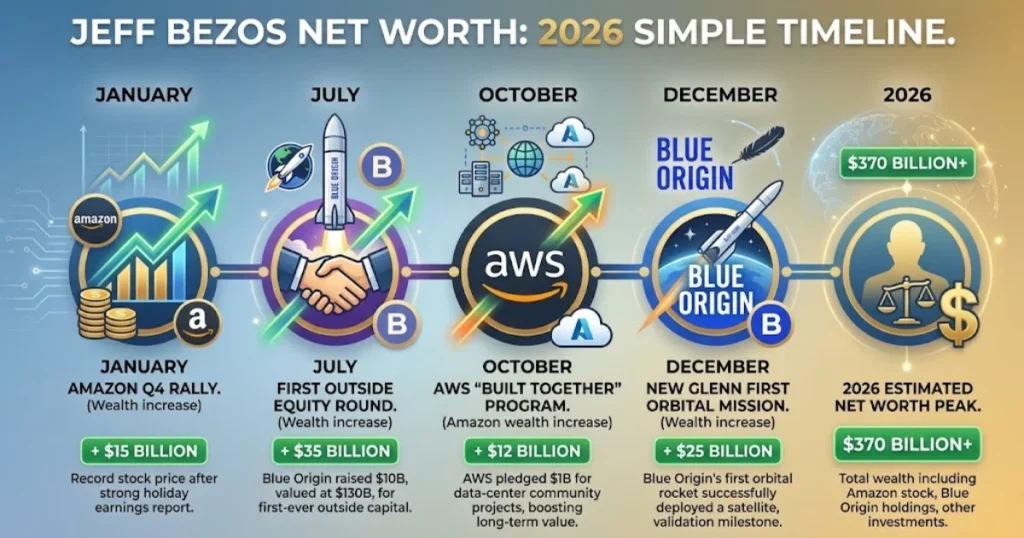
How Jeff Bezos Added 102 Billion in One Month: A Simple Timeline
Let’s walk through the story step by step, so it feels less like magic and more like arithmetic.
- June 2026: Prometheus closed a $12 billion Series B round at a $41 billion valuation.
- July 8, 2026: Reports said Blue Origin was raising $10 billion at a $130 billion pre-money valuation, its first outside round ever.
- September 2026: The round was reported done at a $140 billion valuation, and Forbes estimated that Bezos’s fortune rose by about $102 billion that month.
- October 8, 2026: Bloomberg named him the second-richest person at $368.5 billion.
- October 9, 2026: His Bloomberg figure rose another 2% in a single day to $372 billion, which is up about 48.7% from a year earlier.
Quick math lesson: pre-money valuation is the company’s value before new cash comes in. Post-money valuation adds the new cash. So $130 billion + $10 billion = $140 billion. That is why you see both numbers in the news, and both are correct.
Notice what did not happen here. Bezos did not sell anything. In other words, an outside investor said “this company is worth far more than you thought,” and his ownership was re-priced upward.
Blue Origin Outside Funding Round Valuation 2026: Who Put In What
For 26 years, Blue Origin lived almost entirely on Bezos’s own money. He kept full control and paid the bills mostly by selling Amazon stock. According to a Wall Street Journal report, he had invested about $30 billion in the company since 2000.
This year, that changed. The reported split of the $10 billion round looks like this:
| Investor | Amount |
| Coatue Management (lead) | about $4 billion |
| Large institutional investors | about $4 billion |
| Jeff Bezos himself | $2 billion |
CNBC reported that Bezos put in his own $2 billion on top of the outside money. That is a strong signal, because he is adding to a company he already fully owned.

Why now?
The timing was no accident. A few weeks earlier, SpaceX had gone public in the largest IPO ever, and investors suddenly wanted a piece of anything in space. Bezos had even hinted on TV in May that outside investment was possible. Blue Origin was founded about 18 months before SpaceX, yet SpaceX’s market value is many times larger, so investors saw room to catch up.
The risks nobody should ignore
However, the story is not all sunshine. Blue Origin’s New Glenn rocket put a satellite in the wrong orbit, and a ground test in May ended in an explosion. The company says it wants to fly again before the end of 2026. A valuation is a bet on the future, and rockets can be unforgiving.
Jeff Bezos Private Market Windfall Breakdown: Paper Wealth vs Cash
Now let’s talk about what “net worth” really means. Many readers imagine a giant bank account. In reality, most of this money is paper wealth, which means the estimated value of things he owns.
Here is how his fortune is built today:
- Amazon: He owns about 8% of the company. Bloomberg uses 8.2% from an August 2026 filing. He has also sold more than $49 billion of Amazon stock since the 1997 IPO.
- Blue Origin: Valued at around $130 to $140 billion, and he owned all of it before the outside round.
- Prometheus: Forbes estimates a 20% stake, worth about $8.2 billion at the $41 billion valuation.
- Other assets and cash: The rest of the picture, including investments and property.
A quick anecdote about how fortunes shrink and grow
Back in 2019, his divorce cost him roughly a quarter of his Amazon holdings. He held 16% of the company, and a 4% stake went to MacKenzie Scott. Bloomberg also subtracted about $650 million in cash for other divorce costs. Many people assumed his rise to the top was over. Yet here he is, years later, near the top again, and this time thanks to rockets and AI instead of online shopping.
Why private markets matter more every year
This shift is bigger than Bezos. An SEC staff report found that U.S. private companies raised about $840 billion in the year ending June 2025, while public companies raised about $1.5 trillion. Nasdaq Private Market has also argued that some of today’s biggest fortunes are being built away from the public stock market.
The catch: a private valuation is not the price you would get if you sold tomorrow. It is an agreement between a company and a few investors, so it can be revised, up or down. Meanwhile, Mark Zuckerberg’s AI-driven wealth surge shows how fast a fortune can move when a big bet pays off.
Jeff Bezos AI Company Prometheus Valuation: What $41 Billion Really Means

Prometheus is the more mysterious half of this story. It is run by Bezos and Vik Bajaj, a former chief scientific officer at Verily, as co-CEOs.
Here is what we know, based on Axios’s reporting:
- The company has about 150 employees.
- It is building what its leaders call an “artificial general engineer.”
- The idea is to use AI to speed up how physical products are designed and built, so that work taking years could take much less time.
- Bezos used jet engines as an example: even a modest thrust upgrade to an existing engine can take about a decade today.
- Backers in the $12 billion Series B include JPMorgan, BlackRock, Goldman Sachs, DST Global and Arch Venture Partners.
- Bezos was the largest backer of the earlier $6.2 billion Series A.
Bezos says the startup should work independently because it needs a team that is obsessed with one thing. That is also why it marks a return to hands-on building for him after he stepped down as Amazon’s CEO in 2021.
The honest question: is $41 billion too much?
Here is the part many headlines skip. According to the reports, Prometheus has not yet shown a commercial product or announced a paying customer. So that $41 billion is mostly a bet on what the company might become. For Bezos personally, the stake is small compared with Blue Origin, roughly $8.2 billion by Forbes’s math. Even so, it shows where he thinks the next big thing is. The AI boom is making other founders richer too, and you can see how in our breakdown of Jensen Huang’s AI chip empire.
From a Bellevue Garage to $370 Billion: How the Fortune Began
It helps to remember where this started. Bezos left a Wall Street job in 1994 and began selling books online from a garage in the Seattle area. Later, he explained that he made the leap using a “regret test”: at age 80, would he regret not trying? Most people would have kept the safe job.
Amazon went public in 1997. According to Bloomberg’s history, the stock rose almost 40-fold after the IPO and pushed his fortune above $12 billion. In 2017, he passed Bill Gates, and a month later he crossed $100 billion for the first time.
So, if you ever wonder why one person can build so much wealth, the answer is not one lucky month. It is 26 years of patience with Blue Origin, three decades with Amazon, and a willingness to put his own money in first.
Step-by-Step: How to Track Jeff Bezos’s Net Worth Yourself
Do not rely on a blog post that was written months ago, because this number changes constantly. Instead, follow these simple steps:
- Open the live trackers. Use Forbes Real-Time Billionaires and the Bloomberg Billionaires Index.
- Write down the date and time. Private-company values update about once a day, so timing matters.
- Compare the two figures. If they differ by a lot, check how each one values Blue Origin and Prometheus.
- Look for new funding news. A new round for a private company, like the Blue Origin one, can move the total quickly.
- Check Amazon’s stock price. About 8% of Amazon is still the biggest public piece of his wealth.
- Read the profile notes. Bloomberg’s Bezos profile explains each adjustment in plain text.
Follow these six steps and you will understand the number better than most people who simply repeat a headline.
What Everyday Readers Can Learn from Bezos’s Wealth Story
You do not need $370 billion to take something useful from this. Consider three simple ideas:
- Ownership matters. Bezos kept 100% of Blue Origin for years. When its value jumped, he captured the whole gain. Our MrBeast net worth breakdown shows the same idea in the creator world.
- Long-term thinking wins. The rewards came after decades, not weeks.
- Paper wealth is not cash. Even the richest people hold wealth in assets that can move up or down.
We write about stories like this at Asset Scale Hub because understanding how large fortunes are built is a good first step toward making smarter money decisions of your own. If you like these breakdowns, bookmark the site and come back; we update our net-worth guides as the numbers change.
Disclaimer: This article is for information only and is not financial or investment advice. Figures are based on Forbes and Bloomberg reports from October 8–10, 2026 and may have changed by the time you read this.
Frequently Asked Questions
What is Jeff Bezos’s net worth in 2026?
In early October 2026, Forbes put it at about $370 billion, and Bloomberg showed $372 billion on October 9. Forbes’s real-time page showed $380.8 billion on October 10.
How did Jeff Bezos add $102 billion in one month?
According to Forbes, the September 2026 jump came from the re-valuation of Blue Origin and Prometheus, not from Amazon shares.
Is Jeff Bezos the richest person in the world?
No. Both trackers rank him second, behind Elon Musk, who is around $1 trillion on Bloomberg.
How much of Amazon does Bezos still own?
About 8%. Bloomberg lists 8.2% from an August 2026 filing.
Is Prometheus making money?
Not yet, as far as the public reports show. It has not announced a commercial product or a paying customer.
Can Jeff Bezos’s net worth go down?
Yes. Amazon’s stock price can fall, and private valuations can be marked down if a company struggles.
Final Thoughts
The Jeff Bezos net worth 2026 story is really a story about a shift: from stock-market wealth to private-market wealth. A single funding round at Blue Origin and a strong valuation at Prometheus were enough to add about $102 billion in one month, and push him past Larry Page into second place.
Still, remember the two golden rules. First, check the date on any number you read. Second, remember that a valuation is an opinion until someone actually pays that price.
Want more breakdowns like this? Browse our Tech Founders & CEOs section for more billionaire profiles.