
How billionaires pay without selling stock, this is the main question of the day and we are now presenting 4 amazing ways in this article with facts and figures.
In April 2022, Elon Musk needed $46.5 billion to buy Twitter. He had the wealth on paper, but almost none of it was cash. His money was locked up in Tesla shares. So how did he pay for it? According to NBC News, a group of banks led by Morgan Stanley agreed to lend him $25.5 billion, including a separate $12.5 billion loan secured by his Tesla shares (about Rs 3.47 trillion). He sold some stock too, but the loan is the part most people miss.
A billionaire cannot hand over shares at a shop counter, and selling them can create a big tax bill and weaken their control of the company they built. So the very rich use a handful of other tools. Here is how they actually work, with the real numbers behind them.
The short answer: billionaires pay for things without selling stock mainly by (1) borrowing against their shares, (2) living off dividends, (3) selling small amounts on a fixed schedule, and (4) giving shares away instead of cashing them in.
Rupee figures in this article use Rs 277.5 per US dollar, the open-market rate in Pakistan on October 13, 2026, according to Pak Observer.
Method 1: Borrowing Against Their Shares
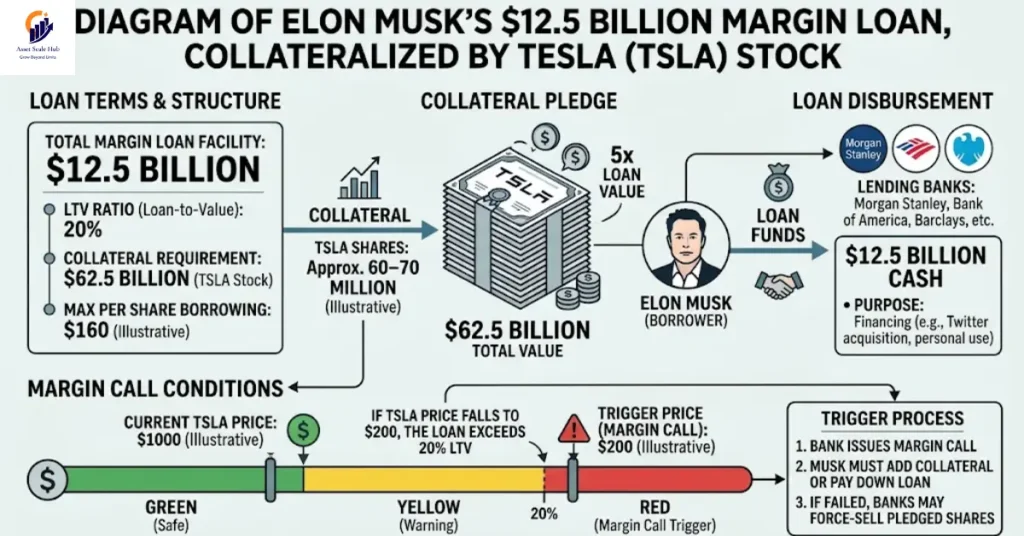
This is the big one. A bank lends the billionaire cash, and the billionaire pledges shares as security, called collateral. If the loan is repaid, the shares come back. If the share price crashes, the bank can demand more collateral or sell some of the shares.
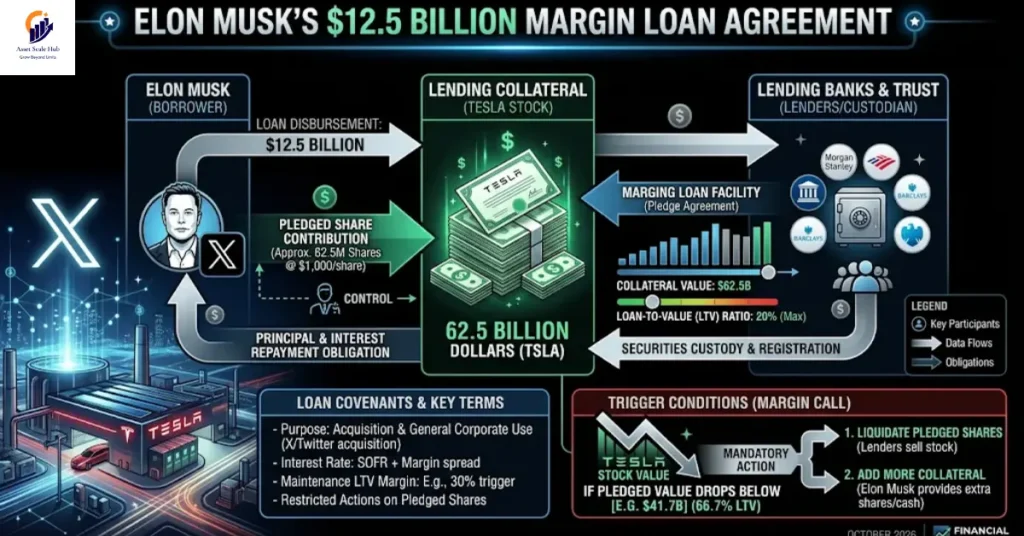
How the Musk loan was built
The Twitter financing documents showed unusually tight terms. According to StreetInsider, the margin loan had a maximum starting loan-to-value of 20% and a margin-call level of 35%. In plain terms: for each $1 he borrowed, he had to pledge about $5 of stock, and if the stock fell far enough, the bank could demand more.
Forbes reported that the $12.5 billion loan was secured by $62.5 billion of Tesla stock, around Rs 17.3 trillion. A later filing showed the loan was cut in half, to $6.25 billion, according to The Next Web.
Tesla’s own limits
Because pledging can put a company at risk, Tesla set rules. According to a Forbes analysis, the board limited loans backed by pledged stock to 25% of the value of the pledged shares, and in 2023 it added a $3.5 billion cap on Musk’s borrowing. The same report says a share price drop in 2015 left Musk facing margin calls, some of which he met by pledging more shares.
The Larry Ellison example
Oracle’s co-founder is the clearest current case. According to Oracle’s 2026 filing, covered by Bloomberg, he pledged 413 million Oracle shares, up from 346 million a year earlier. The Wall Street Journal, summarized by Yahoo Finance, said he also pledged Tesla, SpaceX and Paramount Skydance shares to five banks. Oracle says the loans are used only for outside personal business ventures, that none of the pledged shares are in margin accounts, and that he can repay without selling the pledged shares. You can read the rest of his income in our guide to how Larry Ellison makes money.
Why Borrowing Often Beats Selling
The logic is about tax and control, and it has a name: buy, borrow, die. The phrase is credited to USC tax law professor Edward McCaffery, according to ProPublica’s reporting.
Here is how the pieces fit:
- Buy shares that rise in value over many years.
- Borrow against them instead of selling, because a loan is not a sale.
- Die holding the shares. Under federal law, inherited property generally gets a new tax basis equal to its fair market value on the date of death, according to IRS Publication 551 and 26 U.S.C. §1014. That resets the gain for the heirs.
We explain this idea in full in our upcoming guide to the buy, borrow, die strategy.
What the real tax records showed
In June 2021, ProPublica published leaked IRS data on America’s richest people. Instead of an ordinary tax rate, it calculated a “true tax rate”: taxes paid divided by the growth in a person’s wealth, using Forbes’ estimates. It is not the same as a normal tax rate, and ProPublica says so.
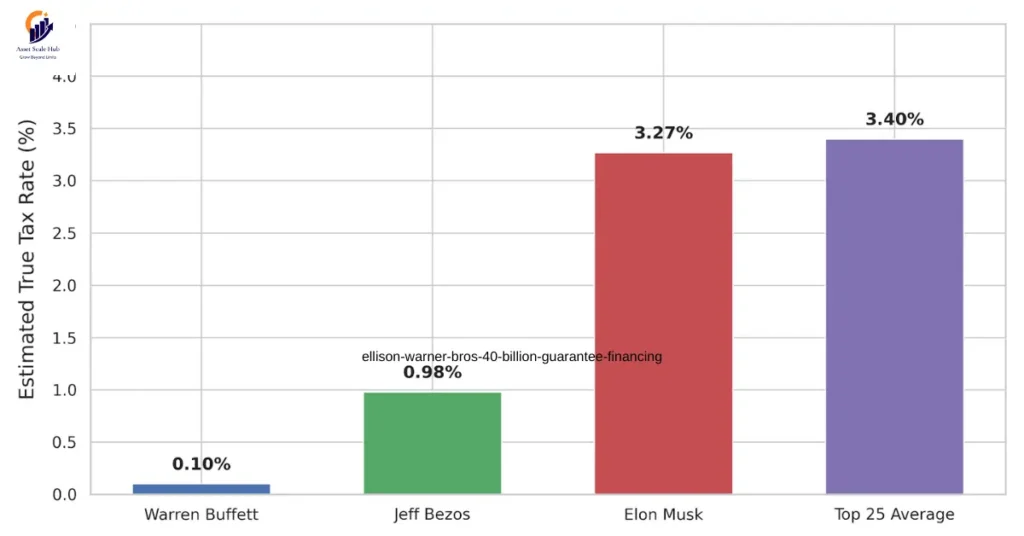
| Person | Period | Wealth growth | Taxes paid | “True tax rate” |
|---|---|---|---|---|
| Jeff Bezos | 2014 to 2018 | $99.0 billion | $973 million | 0.98% |
| Warren Buffett | 2014 to 2018 | $24.3 billion | not shown in the excerpts I read | 0.10% |
| Elon Musk | 2014 to 2018 | not shown in the excerpts I read | not shown | 3.27% |
| The 25 richest Americans | 2014 to 2018 | $401 billion | not shown | 3.4% |
Sources: ProPublica and the Americans for Tax Fairness summary.
ProPublica also reported that Bezos paid no federal income tax in 2007 and 2011, and Musk paid none in 2018. Between 2006 and 2018, Bezos paid $1.4 billion in personal federal taxes while his wealth rose by $127 billion.
Two sides to this
Critics say the system lets the ultra-rich enjoy their wealth without paying much tax. Defenders point out that unrealized gains are not income under current law, that the loans have to be repaid with interest, and that these billionaires also pay large taxes in other ways. The US has not settled the argument, and the numbers above are one nonprofit newsroom’s calculation, not a legal finding. One of the billionaires named by ProPublica objected to the publication of his private tax records.
The Catch: What Can Go Wrong With Stock-Backed Loans
This strategy is not free money. Regulators have warned about the risks for years.
According to a joint FINRA and SEC investor alert, a lender may be able to call a securities-backed line of credit at any time. If the borrower cannot repay, the firm may sell the securities. Banks describe the same terms. For example, J.P. Morgan’s own disclosure says it can change the loan value of a security without notice and sell securities to cover a shortfall.
Billionaires get far better terms than ordinary investors, but the principle is the same. In 2026 Oracle’s stock fell more than 30% from its January level, according to the Forbes report that covered Oracle’s filing, just as Ellison’s pledged shares grew. That is why investors read these filings closely.
Method 2: Living Off Dividends
Some billionaires simply collect cash that their companies pay out. No sale, no loan.
| Company | Dividend | Source |
|---|---|---|
| Oracle | $0.50 per share each quarter | 24/7 Wall St. |
| Alphabet | $0.22 per share each quarter | 10-Q filing |
| Nvidia | $0.25 per share each quarter, since June 2026 | 10-Q filing |
| LVMH | €13 per share a year | LVMH investor page |
The Oracle payment is the one with a headline figure: in July 2026, Ellison collected about $579 million from a single quarterly payment, according to 24/7 Wall St. (about Rs 160.7 billion). Each of the others has its own story, which we cover in the guides to how Sergey Brin makes money and how Jensen Huang makes money.
Not every company pays a dividend. As ProPublica noted, companies like Amazon and Tesla do not, which is one reason their founders lean on loans instead.
Method 3: Selling Small Amounts on a Fixed Schedule
Billionaires do sell stock. They just do it quietly and in small pieces.
- Fixed plans. Jensen Huang sold shares under a Rule 10b5-1 plan adopted in March 2025, according to Finance Monthly. These plans set the dates and amounts in advance.
- Small sales. Sergey Brin sold about 172,000 Alphabet shares for roughly $53 million on February 27, 2026, according to CompaniesHistory. Bloomberg says he has sold more than $11 billion since Alphabet’s 2004 IPO.
- Plans that get dropped. The Wall Street Journal reported that Ellison first planned to sell as many as 50 million Oracle shares, worth about $7.5 billion (Rs 2.08 trillion), before choosing to borrow more instead, according to GuruFocus.
Method 4: Giving Shares Away
Shares can leave a billionaire’s hands without being sold for cash.
- In November 2025, Brin gave about $1.1 billion of Alphabet stock, almost all to his nonprofit Catalyst4, according to Fortune.
- In July 2026, Warren Buffett gave about $6 billion of stock to nonprofits run by his children, according to Benzinga.
The tax treatment of gifts depends on the type of gift and the country, so check with a tax adviser before copying any of this.
A Live Case: Ellison and the Warner Bros. Deal
The best way to see these tools working together is the 2026 bid for Warner Bros. Discovery by Paramount Skydance, which Ellison’s son David Ellison runs.
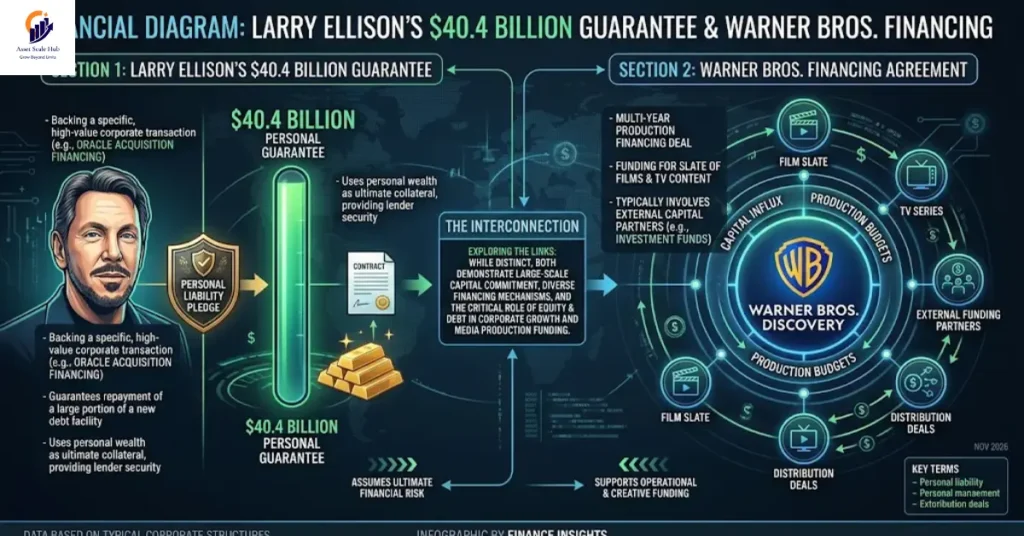
- Larry Ellison gave a personal guarantee for $40.4 billion of the equity financing, according to a Paramount filing with the SEC, around Rs 11.2 trillion.
- Briefs Finance reported that the family committed about $47 billion in equity, with roughly $24 billion from three Middle East sovereign wealth funds.
- To fund his part, he chose to pledge more shares instead of selling the $7.5 billion block mentioned earlier.
So a single deal used loans, outside investors and a dropped sale all at once.
How to Check These Numbers Yourself
You do not need a subscription to follow this. Most of it is public.
- Open the proxy statement of any public company. Look for the section on “pledged shares.”
- Search SEC EDGAR for the person’s Form 4 (trades) and Form 144 (planned sales).
- Read the 10-Q or 10-K for the dividend per share.
- Compare two trackers, like Forbes and Bloomberg, and write down the date.
- Be careful with “true tax rate.” It comes from ProPublica’s method, not from a tax return.
Frequently Asked Questions
How do billionaires pay for things without selling stock?
Mostly by borrowing against their shares, collecting dividends, selling small amounts on fixed schedules and giving shares away.
Can billionaires borrow unlimited money against their stock?
No. Lenders limit the loan to a fraction of the share value, and some companies add their own limits. Tesla’s policy capped loans at 25% of the pledged value, and in 2023 added a $3.5 billion cap for Musk.
What happens if the stock price falls?
The lender can demand more collateral or sell shares. In Musk’s 2022 loan, the margin-call level was set at 35%.
Do billionaires pay taxes on loans?
A loan is not a sale, so it does not create a capital gain the way selling would. Interest and the underlying rules still matter, so ask a tax professional.
What does “buy, borrow, die” mean?
Buy assets that rise in value, borrow against them instead of selling, and hold them until death, when heirs generally get a new tax basis equal to the value at that date.
Is it legal?
These are legal tax-avoidance methods under current US law, which is different from tax evasion. Whether the law should change is a political debate.
Final Thoughts
Billionaires pay for things without selling stock because they have options most people do not: lenders who will accept their shares as collateral, companies that pay them dividends, and tax rules that reward holding. But the tools have a price. Interest has to be paid, lenders can call loans, and a falling stock can turn a comfortable arrangement into a margin call.
If you want to see how this plays out for one founder in real time, start with our Larry Ellison net worth 2026 breakdown and browse more in the Tech Founders & CEOs section.
Disclaimer: This article is for general information and is not financial, legal or tax advice. Figures come from SEC filings, ProPublica, Forbes, Bloomberg, NBC News, FINRA and news reports published between 2021 and 2026, and may change. Tax rules differ by country.